
Cleaning Your Home after a Wildfire
In the last two years, Northern Minnesota has been impacted by two major strings of wildfires. In 2025, the Camp House, Jenkins Creek, and Munger Shaw fires started in mid-May and burned for over a month before being fully contained. This year, the Stewart Trail Fire near Two Harbors burned more than 350 acres, destroyed over 30 buildings including 8 homes and cabins, and left a trail of smoke-damaged properties stretching across the North Shore.
As residents return home, many face significant cleanup challenges. Dryco Restoration Services was consulted by WDIO-TV to provide guidance for local homeowners. You can read the full coverage here: Advice from the Pros for Cleaning Your Home After Fire Damage
Below, we review those professional tips for cleaning your home after a wildfire.
Before You Start: Safety First
Wildfire smoke is not the same as ordinary household dust. It contains carcinogens, heavy metals, and fine particulates that cause serious respiratory harm even at low exposure levels. Before entering a smoke-affected home to begin any cleanup, you need proper protection.
Remaining safe, remaining vigilant — there’s a lot of carcinogens in fires. So what you breathe has a big impact on what you want to take on yourself. — Cole Fechner, VP, Dryco Restoration Services
Minimum PPE for wildfire smoke cleanup:
- Respirator: an N95 is the minimum, but Cole recommends a half-face or full-face respirator for a proper seal. A cloth mask or bandana provides little meaningful protection.
- Nitrile gloves — smoke compounds absorb through skin.
- Clothes you can wash immediately, or a disposable coverall.
- Wash everything you wore — including your hair — before entering your car or a clean area.
Children, elderly family members, and anyone with asthma, COPD, or respiratory conditions should not participate in cleanup.
How to Clean Smoke and Soot the Right Way
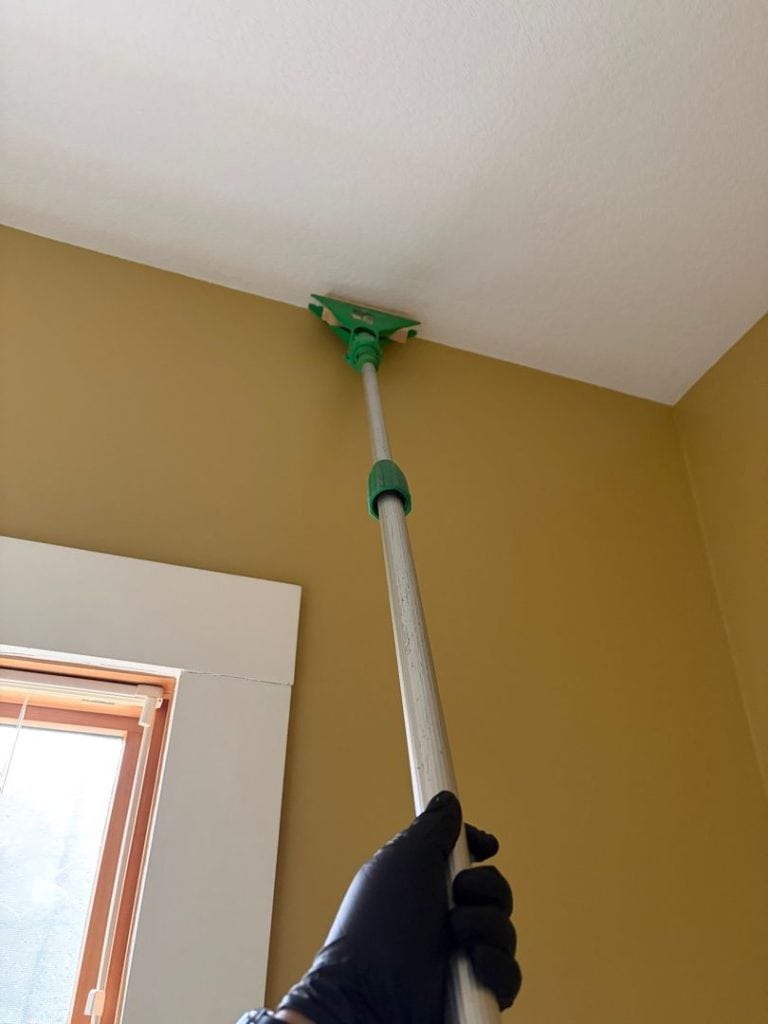
The most common mistake homeowners make is grabbing a damp cloth and wiping surfaces, which smears soot deeper and can permanently stain walls and ceilings. The correct approach is always dry first, then wet.
You don’t want to stir up anything. When you’re cleaning, use a mix of dry and wet techniques to get what soot you can out of there. — Cole Fechner, VP, Dryco Restoration Services
The right sequence for soot removal:
- HEPA vacuum all surfaces first — ceilings before walls before floors.
- Use a dry chemical sponge (soot sponge) on walls and ceilings — long strokes, no scrubbing, no water.
- Follow with an appropriate wet cleaner (alkaline cleaner or TSP solution) on hard surfaces. Clean walls bottom to top to avoid etching.
- Do not paint or seal until all soot is removed and odor treatment is complete.
If you’re going to use a vacuum, make sure it has a HEPA rated filter in it — because if it isn’t, it’s just going to be blowing that particulate back into the air. — Cole Fechner, VP, Dryco Restoration Services
Your HVAC System: Address It Before Anything Else
Many homeowners who evacuated left their HVAC system running — or turned it on immediately upon returning. This is one of the most significant mistakes in wildfire cleanup. A contaminated HVAC system redistributes soot and smoke compounds throughout every room in the house every time it runs.
If you can, number one, replace the filter right away. You can supplement a charcoal filter to help with the odor. But the return ducting is going to be pulling in that smoke and soot — so I would suggest replacing the filter, supplementing a charcoal filter, but then looking to have those ducts cleaned, at least the return. — Cole Fechner, VP, Dryco Restoration Services
Steps to take with your HVAC after a wildfire:
- Turn off the system — do not run it while soot is present indoors.
- Replace the air filter with a MERV-13 or higher rated filter.
- Add a supplemental activated charcoal filter to help absorb odor compounds.
- Have the air ducts professionally inspected and cleaned before resuming normal operation.
Textiles, Upholstery, and Carpet
Soft furnishings are among the hardest things to restore after wildfire smoke exposure. Cole was straightforward about the limitations on WDIO:
For the textiles and upholstery, those are hard to clean, hard to deodorize — just because if there’s furniture padding behind it, it can penetrate really deeply. Same thing with carpet and the pad beneath. Clean it with a mild degreaser and a deodorizer — they make specific deodorizers for smoke damage. — Cole Fechner, VP, Dryco Restoration Services
| Item | DIY Approach | Likely Outcome |
| Clothing and linens | Machine wash twice with white vinegar + detergent | Salvageable if treated quickly |
| Area rugs | Mild degreaser + smoke-specific deodorizer | Usually salvageable |
| Upholstered furniture (light exposure) | Upholstery cleaner + smoke deodorizer spray | Partially effective; professional cleaning better |
| Upholstered furniture (heavy exposure) | Not effective — padding too saturated | Professional ultrasonic/ozone treatment or replacement |
| Carpet | Extract + smoke deodorizer on surface | Surface cleaned; pad beneath often needs replacement |
| Mattresses | Surface cleaning only — foam absorbs deeply | Professional ozone treatment or replacement recommended |
For items that need more than a standard wash, Dryco’s contents cleaning services handle smoke-damaged belongings using ultrasonic cleaning and ozone chamber treatment.
Your Options for Cleaning and Deodorizing After a Wildfire
Not every home needs the same level of intervention. Here is a straightforward look at your options based on the level of exposure:
| Exposure Level | What You Can Do Yourself | When to Call a Professional |
| Light — faint odor, no visible soot | HEPA vacuum, wipe surfaces, replace HVAC filter, use smoke-specific deodorizer | If odor returns after cleanup or intensifies seasonally |
| Moderate — visible soot on some surfaces, odor with windows closed | DIY surface cleaning may address some areas, but HVAC and hidden areas will need professional attention | HVAC duct cleaning, thermal fogging for wall cavities and attic insulation |
| Heavy — soot on ceilings and walls, strong persistent odor | PPE and document before touching; professional remediation is the appropriate path | Full professional remediation: surface cleaning, HVAC decontamination, ozone or hydroxyl treatment, encapsulant primer |
A note on deodorization: opening windows is not a significant deodorization strategy. Smoke odor compounds bond to porous surfaces — walls, insulation, flooring — and continue off-gassing for months without treatment. Professional deodorization uses thermal fogging (which travels the same pathways smoke did) and ozone or hydroxyl treatment to neutralize those compounds at a molecular level.
Dryco Serves Northern Minnesota
Dryco has been part of this community through both wildfire events. We serve the full North Shore, Iron Range, Duluth, and Twin Ports area with 24/7 emergency response and work directly with your insurance carrier throughout the claim process.
Contact Dryco 24/7 | Two Harbors — Fire & Smoke Damage | Duluth — Fire & Smoke Damage | Why Homeowners Choose Dryco
Frequently Asked Questions
Q: How long do I have before wildfire soot becomes permanent?
Soot begins permanently bonding to surfaces within hours to days, depending on humidity, temperature, and soot type. Wet smoke residues (from smoldering fires burning vegetation at lower temperatures) are particularly aggressive. The sooner cleanup begins, the lower the remediation cost and difficulty. Do not wait weeks after returning home.
Q: Can I run my air conditioner after the wildfire smoke?
Not until you replace or inspect the air filter. If your system ran during the smoke event, the return ducts have pulled in smoke-laden air and may have deposited soot in the ductwork. Running the system circulates contamination through the entire home. Replace the filter first, consider a charcoal supplemental filter, and have the ducts inspected before operating normally.
Q: The smell seems gone right now. Is my home clean?
Not necessarily. Smoke odor often reactivates when humidity rises or the furnace comes on in fall. If the underlying compounds haven’t been treated, the smell will return — often more noticeably with seasonal changes.
Q: Is wildfire smoke damage covered by homeowner’s insurance?
In most cases, yes — smoke damage is a covered peril under standard Minnesota policies even without direct fire contact to your home. Document everything before cleaning anything, contact your insurer to open a claim, then call us. DRYCO works directly with adjusters.
Resources
WDIO — Advice from the Pros for Cleaning Your Home After Fire Damage
Dryco — Fire & Smoke Damage Restoration
Dryco — Contents Cleaning Services
EPA — Protecting Indoor Air Quality During Wildfires
CDC — Health Effects of Wildfire SmokeMinnesota DNR — Wildfire Information