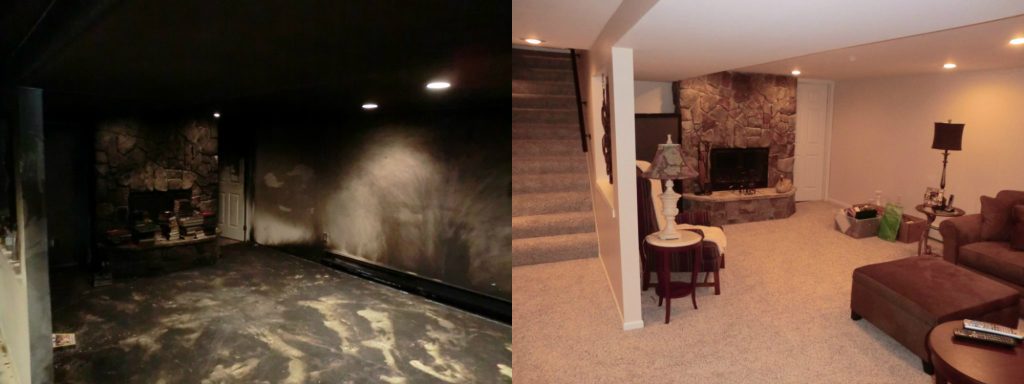
The Professional Smoke Remediation Process for Homes
The restoration industry has spent decades developing and perfecting the smoke remediation process to ensure that your home is successfully restored to its pre-loss condition. If you’re just curious about the process, or you’re dealing with smoke damage and you want to be able to verify that the work is being done correctly, this guide can help.
Step 1: Safety and Structural Assessment
Before the remediation process can start, a restoration professional needs to assess your home’s:
- Structural integrity – Fire weakens wood framing, floor joists, and load-bearing walls. If your home is compromised, a restoration team will need to take steps to stabilize it and ensure that your home can safely support them and their equipment.
- Electrical safety – Smoke residues are conductive, and damaged wiring poses the risk of electrocution.
- Air quality – This will determine the concentration of hazardous materials in the air and what equipment the restoration team will have to wear.
Finally, if you have an older home, professionals will check for asbestos and lead, which are often disturbed by fire. They were commonly used in construction in the Duluth area before the 1980s and, if found, require certified abatement before smoke remediation continues.
Once your home is deemed safe, the remediation process can officially start.
Step 2: Scope Development and Insurance Documentation
Once inside, your remediation team will document every surface, material, and system that was affected by the fire. This will help them determine the scope of the project and how big a crew they will need. It also serves as a record for your insurance provider.
Step 3: Containment and Air Filtration
Before cleaning can start, your remediation team needs to make sure the undamaged portions of your home are protected.
First, they zone off the damaged areas with polyethylene sheeting. Then, they will bring in HEPA air scrubbers that need to run continuously. This filter will capture at least 99.97% of particles as small as 0.3 microns and create a negative pressure space by exhausting air to the exterior, which keeps the smoke particles from spreading.
This step is particularly important in multi-unit dwellings or homes with open floor plans.
Step 4: Contents Removal
Once all the damage from a house fire has been documented, the restoration team can start removing the contents of your home. While the unsalvageable items need to be safely disposed of, salvageable items are transported to a restoration facility where they will undergo a specialized cleaning process.
Each cleaning method is based on the material of the item being restored, meaning everything is well taken care of.
Step 5: Structural Drying (If Water Damage Present)
Fire suppression almost always introduces water damage. Wet surfaces pose a mold risk and can interfere with chemical cleaning agents during the remediation process, so they need to be taken care of before the restoration team can start cleaning the smoke damage.
DRYCO’s teams are well-equipped for water damage restoration. They will use industrial air movers and dehumidifiers while monitoring the moisture levels of the affected areas to ensure they are completely dry.
Step 6: HVAC Decontamination
If your HVAC system has been contaminated and someone turns it on, it will spread smoke particles to unaffected areas of your home. It’s why a lot of restoration teams prioritize it.
The decontamination process involves:
- Sealing all registers before surface cleaning begins
- Inspecting the air handler, blower, and heat exchanger for soot accumulation
- Professional duct cleaning using high-powered vacuum systems and agitation tools
- Replacing the air filter and all return grilles
- Optional duct encapsulation in severe cases
Step 7: Soot Removal — Surface by Surface
Soot removal is the most labor-intensive phase. Restoration teams must ensure they match the cleaning method to the smoke type and the affected material:
| Surface Type | Smoke Type | Method Used |
| Painted drywall | Dry smoke | Dry chemical sponge, then alkaline cleaner |
| Painted drywall | Wet smoke | Dry sponge first, chemical sponge, degreaser — never scrub |
| Wood trim and cabinets | Any | HEPA vacuum, oil soap or alkaline cleaner, encapsulant if needed |
| Concrete/masonry | Any | Wire brush, TSP solution, sealer |
| Metal surfaces | Any | Degreaser, rust inhibitor if oxidation present |
| Insulation | Any | Typically requires replacement — cannot be adequately cleaned |
| Ductwork (sheet metal) | Any | HEPA vacuum, chemical fogging, encapsulant |
The order surfaces are cleaned in also matters, as working from the top down prevents recontamination. Ceilings are cleaned before walls, which are cleaned before floors.
Step 8: Odor Neutralization
Once all the visible soot has been cleaned, odor treatment begins. Professional odor neutralization combines a few methods to ensure the stench of smoke is fully eliminated:
Thermal Fogging
A petroleum-based or water-based deodorizing agent is converted to a fog using heat, creating particles that mimic the behavior of smoke. This fog penetrates the same pathways smoke traveled — wall cavities, subfloors, attic spaces — and chemically bonds with and neutralizes odor molecules.
Ozone Treatment
Industrial ozone generators produce ozone (O3), an unstable oxygen molecule that reacts with and destroys odor compounds. Ozone treatment requires the structure to be fully evacuated — ozone at remediation concentrations is harmful to humans, plants, and pets. It is highly effective for whole-structure odor elimination.
Hydroxyl Generation
Hydroxyl generators produce hydroxyl radicals that react with and destroy odor molecules. Unlike ozone, hydroxyl treatment is safe for occupants. It is slower but appropriate when parts of the structure must remain occupied.
Encapsulant Sealers
After odor treatment, an odor-blocking primer (such as KILZ 3 Premium or BIN shellac-based primer) is applied to all surfaces before painting. This seals any remaining odor molecules into the substrate and prevents future off-gassing.
Step 9: Reconstruction and Restoration
If areas of your home have been too badly damaged, cleaning is not going to help. Instead, the damaged materials (drywall, insulation, flooring, and structural components) need to be replaced according to local building codes. If you live in Duluth, you will need to get permits for the reconstruction process.
Once the materials are successfully installed, the remediation team will use an odor-blocking primer and two coats of finish paint to restore your home to its pre-damage look.
Step 10: Final Clearance Testing
Before your home is deemed livable, it needs to go through one final air quality test to confirm that particulate counts and volatile organic compound (VOC) levels meet safe indoor air quality standards.
This test provides documented proof that the smoke remediation process is complete, which is important for your health and for closing the insurance claim.
To learn more about the smoke remediation process and what it might look like for your specific situation, contact DRYCO for a free consultation. We serve the entire Duluth region including Hermantown, Cloquet, and Superior, WI.
Frequently Asked Questions
Q: How do I know if a restoration company is using the right methods?
Ask if they are IICRC-certified and whether they follow the IICRC S700 Standard for Professional Smoke and Soot Remediation. Request a written scope of work before any work begins, and ensure it specifies methods for each surface type.
Q: Does smoke remediation require permits?
Remediation itself typically does not require permits. Reconstruction work — structural repairs, electrical, plumbing — does require permits.
Q: Can smoke remediation be done in phases?
Yes, though it is less efficient. If cost or logistics require phased work, prioritize HVAC decontamination and containment first, followed by structural drying, then surface cleaning, and finally odor treatment. Never do odor treatment before soot removal — it is ineffective.
Q: What is the IICRC S700 standard?
The IICRC S700 is the industry reference guide for professional smoke and soot remediation. It establishes minimum standards for assessment, containment, cleaning methods, and clearance testing. Choosing an IICRC-certified contractor ensures they are trained to these standards.
Resources
DRYCO Internal Resources:
Fire & Smoke Damage Restoration Services
External Resources:
IICRC S700 Standard for Professional Smoke and Soot Remediation