
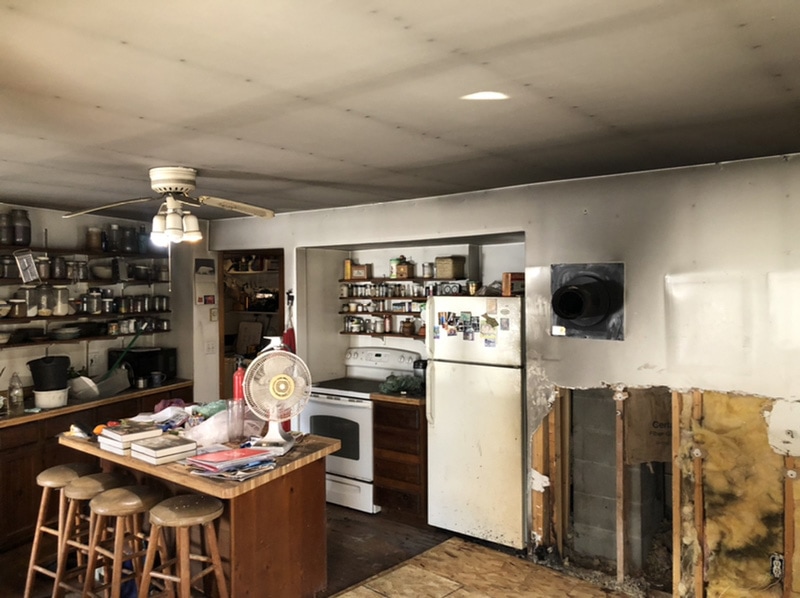
Wildfire Smoke Odor Removal: What Works and Why
Wildfire smoke odor removal is among the most persistent challenges in property restoration. Homeowners who complete a full surface cleaning still find themselves living with a smell that intensifies on warm days or returns when the furnace comes on.
Smoke odor compounds can bond to porous materials at a molecular level and require neutralization, not just dilution or masking. Effective wildfire smoke odor removal depends on treating that underlying chemistry, not just the visible surface.
Why Wildfire Smoke Odor Persists
Wildfire smoke contains hundreds of organic compounds that can condense onto indoor surfaces and penetrate porous materials, making odors difficult to remove.
As temperature and humidity rise, these bound compounds re-volatilize and off-gas back into the air. This is why the odor often seems to disappear under cool, dry conditions and return sharply when the heating system turns on or humidity increases in spring. The source was never eliminated, only temporarily suppressed by temperature and humidity.
Odor sources hidden from view are the most problematic: inside wall cavities, in attic insulation, under flooring, in subfloors, and throughout HVAC ductwork. The hidden sources can continue off-gassing for extended periods if not properly remediated, which is why thorough wildfire smoke odor removal has to reach these hidden areas, not just the rooms people can see.
Methods Compared: What Works, What Does Not
The table below compares common approaches to wildfire smoke odor removal, from DIY methods to professional treatments.
| Method | How It Works | Effectiveness for Wildfire Smoke | Limitations |
| Open windows / ventilation | Dilutes airborne odor by cycling new air throughout the property. | Low to Moderate | Does not address compounds bonded to surfaces or in wall cavities. Not effective if outdoor air quality is also low. |
| Air fresheners / candles | Introduces competing fragrance | None | Masking only; adds chemical load to indoor air |
| Baking soda | Mild alkaline neutralizer for surface odors | Low to moderate | Surface contact only; minimal penetration |
| White vinegar | Mild acid; neutralizes some alkaline smoke residues | Low to moderate | Surface-level only; insufficient for the depth of some wildfire smoke compounds |
| Activated charcoal / carbon | Adsorbs airborne VOCs passively | Moderate (maintenance) | Not a primary treatment; useful as an ongoing supplement |
| Ozone treatment (professional) | O3 oxidizes many odor-causing compounds throughout accessible areas of the structure; full evacuation required | Moderate to High | Requires full evacuation; degrades some rubber and plastics |
| Thermal fogging | Heated deodorizing agent follows the same pathways the smoke traveled | Moderate to High | Must be applied after soot removal; requires temporary evacuation |
| Hydroxyl generation | Hydroxyl radicals neutralize VOCs without full evacuation | Moderate to High | Slower than ozone; better for occupied or partially occupied spaces |
| Encapsulant sealer (primer) | Seals remaining compounds permanently before repainting | High (as final step) | Not a standalone treatment; must follow active neutralization |
The Professional Deodorization Sequence
Permanent odor elimination requires methods applied in a specific sequence. Skipping steps or changing the order produces incomplete results.
- Complete soot removal first. Soot is itself an odor source. Deodorization applied over unremoved soot is ineffective over time.
- HVAC decontamination. A contaminated duct system will re-contaminate cleaned areas on every cycle. This must be addressed before deodorization.
- Thermal fogging of the structure. The deodorizing fog is applied to the closed structure and allowed to penetrate wall cavities, subfloors, attic spaces, and ductwork. It follows the same pathways the smoke originally traveled.
- Ozone or hydroxyl treatment. The structure is treated with industrial ozone (with full evacuation) or hydroxyl generation to oxidize or neutralize many remaining odor-causing compounds throughout accessible areas of the structure.
- Ventilation and re-entry assessment. The structure is thoroughly ventilated and, when appropriate, evaluated to confirm it is safe for re-occupancy.
- Encapsulant primer on all affected surfaces before any painting. This creates a permanent physical barrier preventing off-gassing through new paint.
- Final air quality clearance testing. Confirms VOC levels meet safe indoor air standards.
Ozone Treatment: What Homeowners Need to Know
Industrial ozone (O3) treatment is one of the most effective methods for whole-structure odor elimination. Several important facts for homeowners:
- Full evacuation is required. All people, pets, and plants must leave the structure. Ozone at remediation concentrations (1-10 ppm) is harmful to respiratory systems and to living plant tissue.
- Treatment duration is typically 24-72 hours for a whole home, depending on severity. The equipment is turned off periodically during this time frame.
- The home must be ventilated for several hours after treatment before re-entry.
- Ozone degrades rubber seals, some plastics, and certain dyed fabrics at high concentrations. A professional will advise on what to remove or protect.
- Consumer ozone machines are generally not capable of producing or safely sustaining the treatment conditions used in professional structural remediation. Consumer equipment will likely fail to fully combat odor throughout a structure.
Thermal Fogging Explained
Thermal fogging is particularly valuable for wildfire smoke odor removal because it addresses hidden odor sources surface cleaning cannot reach. A deodorizing agent is converted to a fine fog that travels the same pathways the smoke traveled: inside wall cavities, behind baseboards, and into porous surfaces. It is often one of the most important steps in the deodorization sequence.
If your home has suffered from wildfire damage, contact professionals like the Dryco team immediately. We’re available 24/7 in the Duluth area.
Frequently Asked Questions
Q: The professional treated my home with ozone and the smell is gone. Is it done?
Ozone treatment oxidizes many odor-causing compounds throughout accessible areas of the structure. In some cases, it may be all that is needed to eliminate wildfire smoke odor. If your property is severely contaminated, it may only account for one step in a comprehensive remediation process. In those situations, ozone treatment should be preceded by structural cleaning and followed by encapsulant primer on affected surfaces to reduce the risk of residual odors returning.
Q: Can I speed up the process by increasing ventilation?
Ventilation helps remove airborne compounds but does little to address compounds bonded to surfaces and building materials. It is a useful supplement to professional treatment, not a substitute. Running fans and opening windows after professional treatment helps clear residual treatment products and is actively encouraged.
Q: How do I know when odor treatment is complete?
Professional remediation may conclude with post-remediation air quality testing, depending on the project scope. When testing is performed, VOC measurements can help document the effectiveness of treatment. A sniff test alone is often insufficient as a clearance standard.
Q: My neighbor’s house was treated and the smell came back in six months. Why?
When smoke odor returns after professional treatment, it often indicates an untreated source: insulation that was not replaced, a subfloor area that was not addressed, or a duct system that was not fully cleaned. A follow-up assessment identifies the remaining source and targets it specifically.
Resources
Dryco:
Fire and Smoke Damage Restoration
Silver Bay Fire and Smoke Damage
Grand Marais Fire and Smoke Damage
External:
EPA: Volatile Organic Compounds and Indoor Air Quality
IICRC S700: Smoke and Soot Remediation StandardsAirNow: Real-Time Air Quality Monitoring