
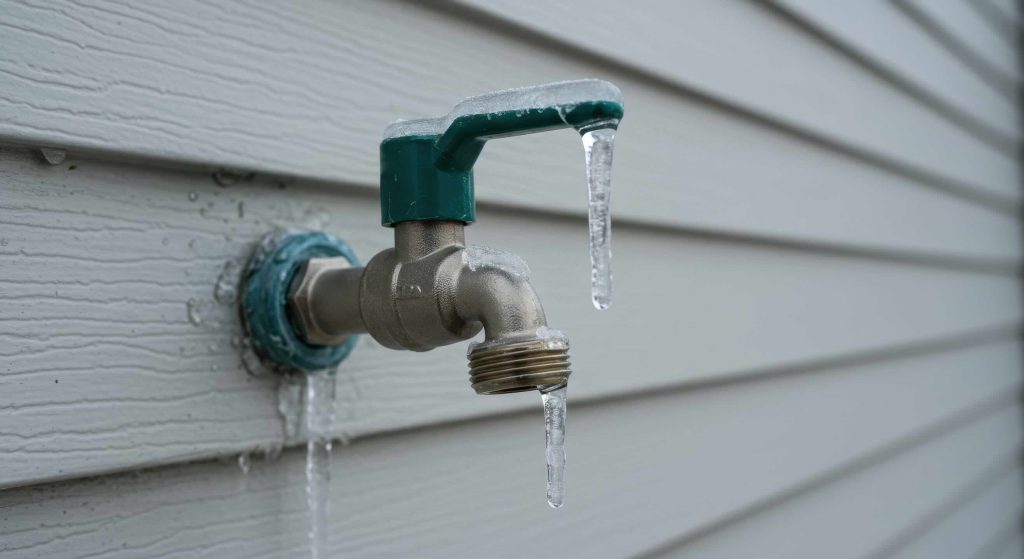
Frozen Pipe: What to Do Right Now (How to Thaw It Safely and When to Stop and Call for Help)
If you turn on your faucet during winter and all that comes out is a trickle, or nothing at all, your pipes have probably frozen. This doesn’t mean that they’ve burst, but it does mean that the next few minutes are crucial. Knowing how to thaw frozen pipes safely will help you protect your home from water damage.
A note about Dryco. We are a water damage restoration company, not a plumbing company. We do not thaw or repair pipes. You can call us if a burst pipe has caused water damage.
| The short answer Open the affected faucet and check for leaks. If you find one, shut off the main water supply and call a plumber. If there are none and you can reach the frozen section, warm it gently with a hair dryer, heating pad, or towels soaked in hot water. Start near the faucet and work toward the cold section. Never use an open flame. If you see a leak or cannot reach the pipe, stop and call for help. |
Before You Touch Anything: A Safety Check
Take a moment to run through these checks and prevent a potential mistake:
- Confirm the main water valve is open and ensure someone hasn’t accidentally shut off the water supply.
- Check other faucets. If one pipe froze, others may have too.
- Check whether your neighbors have water. If the whole street is out, it may be a city main break and not your pipe.
- Look for signs of a split: A wet spot, a drip, a stain, or the sound of running water.
- Make sure you are not standing in water. State Farm and the Red Cross both warn against using electrical devices near standing water.
| If you see any sign of a leak Shut off the main water valve right away. Leave the faucets open so the pipes drain. Stay out of standing water and keep away from electrical devices. Call a plumber to assess and repair your pipe. If your home has water damage, call a restoration company. Do not start thawing. |
The Decision Path
Step 1: Open the Faucet
Keep the faucet open while you thaw the frozen pipe. This will keep water flowing and move the rest of the ice as it starts to thaw. It also gives the pressure somewhere to go.
Open the faucet on the affected fixture and leave it open until water runs at full pressure.
Step 2: Find the Frozen Section
You need to know where the ice is. The most likely places include pipes against exterior walls and the place where your water service enters the home through the foundation. Start with these spots.
| Where to look | What to check |
| Under sinks on exterior walls | Open the cabinet and feel the exposed pipes for unusually cold sections. |
| Where the water line enters the house | Check around the meter and main water valve. |
| Garage and attic pipes | Look for frost or a pipe that is colder than the rest. |
| Exposed pipes in a basement or crawl space | Check along the rim joist and near vents or gaps. |
| Outdoor hose bibs | Check outdoor faucets and their connecting supply pipes. |
A pipe that is visibly frosty or bulging is a strong sign that it may be frozen. If you can’t find the frozen section, or if it’s inside a wall or ceiling, DON’T cut into the wall. Call a plumber.
Step 3: Apply Gentle Heat
Now you can warm the pipe, but don’t rush it. A gentle and steady method, such as wrapping an electric heating pad or towels soaked in hot water around the pipe, using a hair dryer or portable space heater kept away from anything flammable, will keep your pipe intact.

Figure 1. Safer heat sources and the ones you should never use.
It’s important that you start warming the pipe as close to your faucet as possible and work your way toward the coldest section. This way any melted water should drain out through the open faucet as you go.

Figure 2. Heat from the faucet end first. Keep the faucet open.
| Method | Good for | Watch out for |
| Electric hair dryer | Accessible pipes under sinks and in basements. | Never use it near standing water. Keep the cord dry. |
| Electric heating pad | Straight, reachable sections of pipe. | Make sure the pad and cord stay dry. |
| Towels soaked in hot water | Pipes where you cannot use electricity. | Re-soak as the towels cool. |
| Portable space heater | Warming a cold cabinet or small space. | Keep it away from anything flammable. Never leave it unattended. |
Keep applying heat until full water pressure returns. How long that takes depends on the location, the method, and how solid the ice is.
What Not to Do
If you’re not careful about how you thaw frozen pipes, a mistake can lead to fires, injuries, and burst pipes.
- Never use a blowtorch or open flame. Fire can heat the water in the pipe too quickly, causing it to boil and the pipe to burst. You may also set your house alight if you’re not careful.
- Never use a propane or kerosene heater, or a charcoal stove. These are fire and carbon monoxide risks.
- Don’t pour boiling water on a pipe or down a drain, as it may refreeze and add stress to the pipe.
- Don’t use electrical devices near standing water. You could be electrocuted.
- Don’t cut into finished walls to hunt for ice. Call a plumber instead.
When to Stop and Call for Help
Some situations are beyond a safe do-it-yourself job. If you find yourself in one, stop and call for help.
| Situation | Who to call |
| You cannot find the frozen section | A licensed plumber |
| The frozen pipe is inside a wall, ceiling, or floor | A licensed plumber |
| You see a wet spot, drip, or hear running water | Shut off the main valve. Then call a plumber and Dryco. |
| Water pressure does not return after a reasonable effort | A licensed plumber |
| You smell burning or see scorching near a heat source | Stop using it. Unplug it IF it’s safe to do so. Call 911 if there is a fire. |
| Water is already pooling or spreading | Dryco, right away, and a plumber for the pipe |
After the Thaw: Do Not Stop Yet
Even after you’ve successfully thawed your pipes, the job isn’t finished yet. A frozen pipe can be weakened, and a split can stay plugged by ice until it melts. Turn the faucets on slowly and look at every visible pipe and fitting.
- Check under sinks, ceilings below, and basements for drips or stains.
- Listen for running water when everything is off.
- Check all other faucets. If one pipe froze, others may have.
- Keep a faucet dripping until the cold snap is over.
Why Waiting for a Warm-Up Is a Gamble
It is tempting to wait for the weather to warm and let the ice melt on its own. While that may work occasionally, it’s often a gamble. A pipe may have already split, with ice being the only thing that kept it closed. When that ice melts, the water will start leaking, leaving you an even bigger problem to deal with.
Waiting also means you may not discover an existing crack until the ice melts. A split can form while the pipe is blocked. If you can that the pipe safely, it’s better to do so than hope it resolves itself. And if you can’t, it’s always better to call a plumber.
If the Pipe Has Already Burst
If your pipe has split, shut off the main valve, keep faucets open, and stay out of standing water. Then take photos and call for help.
Every minute matters. A one-eighth-inch crack can spray more than 250 gallons of water a day. Dryco is available 24/7. In Duluth and the Twin Ports area, we aim to be on site within 60 minutes. We extract the water, remove materials that cannot be dried, and set up drying equipment.
See our guides on What To Do If You Have a Frozen Pipe Burst, or contact Dryco 24/7.
Frequently Asked Questions
Q: Can I use hot water to thaw a frozen pipe?
You can wrap towels soaked in hot water around your pipe, but don’t pour boiling water directly on a pipe or down a drain. It can refreeze and stress the pipe.
Q: Should I turn off the water before I thaw a pipe?
If there’s no sign of a leak, keep the faucet open while you thaw your pipe. If you see or hear signs of a split, shut off the main valve, then call a plumber.
Q: How long does it take to thaw a frozen pipe?
It varies. A reachable pipe warmed with a hair dryer or heating pad may thaw in about half an hour to a few hours. A pipe inside a wall can take longer. Keep applying heat until full pressure returns.
Q: Is a space heater safe for thawing pipes?
A portable space heater can be an option if it is kept away from anything flammable. Never leave it unattended. Never use a propane or kerosene heater.
Q: Will a frozen pipe thaw on its own?
It often will when the weather warms. But waiting can leave the pipe under stress, and a hidden split can start leaking as soon as the ice melts. If you can thaw it safely, that is usually the better option. Learn more about frozen pipe burst damage.
Q: Do I need a plumber?
Call a plumber if you cannot find or reach the frozen section, if it is inside a wall, if pressure does not return, or if you see any leak. A licensed plumber can safely assess and repair the problem.
Q: Does Dryco thaw pipes?
No. Dryco is a restoration company, not a plumbing company. We handle the water damage if a pipe splits: extraction, drying, and documentation for your insurance claim. A plumber thaws and repairs the pipe.
Resources
Dryco:
What To Do If You Have a Frozen Pipe Burst
How to Mitigate Water Damage Until Help Arrives
External:
American Red Cross: Frozen Pipes
State Farm: Water and Ice, Not So Nice
IBHS: Winter ReadyLive Science: Why Do Freezing Pipes Burst?